





AI Summary
Key points of this article, generated by AI.
Generating AI Summary
You are interacting with an AI system. AI-generated responses may not always be accurate or complete. Please verify important information before relying on it.
Examining enterprise spending, AI agents, and measurable business impact.
Abstract
AI budgets are growing as enterprises deploy assistants and agents in service, software engineering, and business operations. The investment decision starts with a specific outcome and the full cost of achieving it.
This paper examines where enterprises spend, how they deploy agents, and what the research shows about returns. It offers an investment framework, a reference architecture, and a 90-day roadmap for testing value before expanding deployment.
The evidence spans modeled spending, surveys, company disclosures, and controlled studies. These sources support different conclusions about adoption, productivity, and financial returns.
Executive implications
Prioritize workflows with sufficient transaction volume, accessible enterprise data, and verifiable outcomes. Establish the financial baseline before introducing AI. Give each deployment a business owner accountable for realizing benefits and an engineering owner accountable for quality and production cost.
Expand autonomy only when evaluations and operating results support it. Shared data access, integration and governance capabilities can improve the economics of subsequent deployments, but their costs must remain visible in the investment portfolio
Where Is Enterprise AI Spending Going?
A prominent venture capital firm estimates enterprise AI deployment spending at a $176.8 billion annualized run rate as of September 2026, about 5.4 times its reclassified $33 billion prior-year baseline. Together, coding and workplace assistants account for about 76% of estimated application spending.
|
Spending category |
2026 estimate |
Investment implication |
|
Deployment infrastructure |
$99.5bn |
Model access, inference and agent infrastructure |
|
AI applications |
$77.3bn |
Business and employee applications |
|
Coding applications |
$34.0bn |
Subset of application spending |
|
Chatbots and assistants |
$25.0bn |
Subset of application spending |
The firm combined a market model with a survey of nearly 400 US decision-makers. Its estimates represent annualized revenues, and it invests in AI companies including Anthropic.
The enterprise budget extends beyond model access
A production budget should include application engineering, data preparation, system integration, evaluation, security, operations, and adoption. This cost taxonomy is a planning recommendation; the reviewed sources do not establish a standard percentage allocation across these categories.
BCG surveyed 423 senior IT buyers in May 2026. Respondents prioritized AI through budget growth and reprioritization, reporting an average measured ROI of 13.8%.
Keep market measures separate
Enterprise purchases, model development expenditure, and hyperscaler capital investment measure different economic activities. Adding them can double-count flows through the AI supply chain. Reuters notes that company capex disclosures do not consistently isolate AI spending. Investment committees should compare figures only after checking scope, period, and methodology.
How to Build an Enterprise AI Agents Portfolio?
An enterprise agent uses a model to select and execute steps toward a defined objective, usually through tools and business systems. An assistant may instead retrieve information or prepare an output for a person. Both can generate value; their operating controls and investment cases differ.
|
Portfolio area |
Typical scope |
Business measure |
|
Engineering |
Issue analysis, code changes, tests and review preparation |
Accepted changes and delivery quality |
|
Modernization |
Dependency upgrades, code transformation and validation |
Cost per migrated application |
|
Customer operations |
Intent classification, account retrieval, resolution and escalation |
Cost per resolved issue |
|
Knowledge and documents |
Approved guidance, extraction, comparison and drafting |
Review effort and turnaround |
|
Commercial workflows |
Recommendations, matching and personalized assistance |
Incremental contribution margin |
|
Operational workflows |
Case triage, data updates and coordinated processing |
Cost per completed process |
Anthropic’s agent report, based on more than 500 US technical leaders surveyed in late 2025, found that 57% reported multistage workflows, including 16% spanning multiple functions. Data analysis and reporting, as well as internal process automation, were prominent uses beyond engineering. These are vendor-sponsored survey findings.
Match autonomy to the decision
A practical portfolio can contain retrieval assistants, agents that prepare actions for approval, and agents permitted to execute bounded actions. The permitted mode should reflect the reversibility of the action, confidence in the evidence, and the consequences of error. A payment exception may require an approver even when a document-classification task can run unattended.
Use a conventional rule or workflow when the task is deterministic. Add model reasoning when interpretation or adaptation yields sufficient benefit to justify the additional uncertainty and operating costs. More agents should follow from business requirements, rather than becoming a success metric in their own right.
Where Enterprise AI Agents Deliver Business Value?
Customer service at a global fintech company
A global fintech company’s 2025 annual filing estimates approximately $59 million in customer-service cost savings from its AI assistant in 2025. The assistant handled 80% of customer-service chats that year, according to internal logs. The filing also states that customers retain access to human representatives.
For service deployments, track repeat contacts, escalations, and satisfaction alongside handling costs. The company disclosure provides an estimate of savings. Calculating net ROI also requires total AI costs.
Application modernization at Amazon
Amazon reports using Amazon Q Developer to upgrade tens of thousands of production applications to Java 17. It estimates more than 4,500 developer-years of equivalent manual effort saved and $260 million in annual performance-related savings.
The transferable lesson is the value of a bounded target. Builds, tests, and deployment checks help verify technical outcomes, while infrastructure changes can be measured against a cost baseline. A modernization business case should separate delivery capacity released from ongoing operating savings.
Specialist knowledge and commercial assistance
OpenAI reports that a major Spanish multinational financial services group’s legal chatbot automates more than 9,000 queries annually and has enabled the redeployment of the equivalent of three full-time employees. Its Indeed case reports experiments in which AI-generated explanations increased application starts by 20% and downstream interview and hire success by 13%. These are supplier-published customer results.
The group illustrates capacity release. Indeed illustrates a commercial funnel improvement. A financial assessment would value each outcome against the cost of achieving it.
Maintain a route to human resolution
Reuters reported that companies were reinforcing human support for complex or empathy-dependent interactions. This is economically relevant: unresolved cases and repeated contacts can offset the apparent savings from automation. Service quality belongs inside the business case.
What Does Research Say About AI Productivity?
The studies below measure different outcomes across support and software development. Use their findings to design a test on the work your teams perform.
|
Study |
Result |
Interpretation |
|
Generative AI at Work |
About 15% more support issues resolved per hour |
Evidence from one firm using employee assistance |
|
Three developer field experiments |
26.08% more completed tasks across 4,867 developers |
Randomized studies with variation and statistical uncertainty |
|
METR early 2025 trial |
19% longer completion time across 246 tasks |
16 experienced developers working in familiar repositories |
|
METR May 2026 survey |
Median self-reported work value increase of 1.4 to 2 times |
349 technical workers; perception rather than measured causal uplift |
The supporting study, published in the Quarterly Journal of Economics, demonstrates a task-level improvement. It does not estimate company-wide profit or employment effects. The developer field experiments found greater gains among less-experienced developers; their pooled results should not be applied unchanged to every engineering team.
Read the METR findings over time
In Model Evaluation & Threat Research, METR’s early-2025 trial, experienced developers took longer on familiar codebases despite believing AI had helped. The result applies to the tools and tasks tested.
METR’s February 2026 update identified participant selection and concurrent agent use as limits on its follow-up estimate. Its May survey measured perceived gains.
Measure completed work and its consequences
For engineering, track accepted changes, review time, rework, escaped defects, and service reliability. For knowledge work, track time to an approved output and correction effort. Use randomized or staged comparisons where practical. Keep employee experience as a separate benefit, and avoid converting self-reported hours directly into financial savings.
How to Measure AI ROI and Investment Returns?
Use these six decisions to select, fund, and manage AI deployments.
- Define the business outcome
Choose a process with a measurable problem and a named business owner. Record baseline volume, handling cost, cycle time, quality, and exceptions. Specify the outcome to improve, such as a successfully resolved service case or a validated application upgrade. - Establish the financial realization path
Finance should identify how the benefit will reach the business. Reduced supplier invoices, avoided overtime, and lower infrastructure bills are different from employee capacity released. Count incremental sales using contribution margin. Treat risk reduction as an explicitly modeled estimate unless losses avoided can be observed. - Design the workflow and approval boundaries
Map the steps, systems, required evidence, and decisions. Identify where retrieval is sufficient, where an agent should prepare an action, and where execution is permitted. Define what happens when the model cannot proceed, a tool fails, or evidence conflicts. - Validate quality and unit economics
Evaluate representative cases, difficult exceptions, and failure conditions before broad rollout. Compare total cost per successful outcome with the baseline. Include review, retries, and downstream correction. A faster response has little economic value when it increases rework. - Release investment against operating evidence
Fund expansion in stages. The next release should depend on observed quality, cost, and adoption, using thresholds agreed before the pilot. Retain the option to simplify the design or discontinue the use case. Strategic infrastructure investments may have a longer horizon, but still need explicit beneficiaries and cost ownership. - Reassess the portfolio
Review benefits and operating costs with finance and business owners. Reallocate funding as demand, capability, and pricing change. Gartner’s 2026 survey associates active portfolio measurement with stronger reported results.
AI Cost Optimization: Measure Cost per Successful Outcome
Divide total workflow costs by the number of accepted outcomes. Count the cost of failed attempts, retries, and review in the numerator.
|
Cost component |
What to include |
|
Implementation |
Integration, data preparation, workflow design and initial validation |
|
Runtime |
Model usage, retrieval, tools, orchestration and infrastructure |
|
Assurance |
Human review, evaluations, security and monitoring |
|
Exceptions |
Escalation, retries, incident response and correction |
|
Adoption and change |
Training, process redesign and ongoing maintenance |

Illustrative service operation business case
Consider one million annual service cases, with 300,000 safely resolved by AI. Assume an avoidable human servicing cost of $6 for each case resolved, annual AI operating costs of $600,000, and first-year implementation costs of $400,000. These are illustrative assumptions, not industry benchmarks.
|
First-year measure |
Illustrative value |
|
Gross financial benefit |
300,000 × $6 = $1,800,000 |
|
Total first-year cost |
$600,000 + $400,000 = $1,000,000 |
|
Net benefit |
$800,000 |
|
ROI using net benefit divided by total cost |
80% |
|
ROI if only half the servicing cost is avoidable |
−10% |
The sensitivity to avoidable costs is decisive. Time-released creates a financial saving only when expenditure falls, or additional value is realized. A finance-approved model should prevent double counting the same benefit as payroll savings, capacity release, and new revenue.
For multiyear investments, assess discounted cash flows, payback, and cost uncertainty. Allocate shared platform costs transparently and show both marginal deployment economics and the total portfolio investment.
How to Build an AI Operating Model That Scales?
Production architecture affects the return as directly as model selection. A workflow that needs repeated retries, excessive context, or constant manual intervention can consume the value demonstrated in a pilot.
Make enterprise context usable
Connect agents to authoritative documents and business systems through permission-aware retrieval and controlled APIs. Preserve data provenance and policy versions. Business terms, eligibility rules, and approval authority should be explicit enough for both the agent and the reviewer to interpret consistently.
Control execution and recover from failure
Give agents identities and access limited to their responsibilities. Record consequential actions and support cancellation, rollback, or compensating actions where the business process allows them. Set limits on tool calls, elapsed time, and spending. Approval requirements should reflect the consequence of the action.
Evaluate the workflow continuously
Maintain representative evaluation cases and track quality after changes to models, prompts, retrieval, or tools. Instrument the complete process so teams can identify whether failure came from missing data, reasoning, system access, or execution. Connect these traces to cost and business outcomes.
Select models using successful outcome cost
A higher-priced model can be economical when it reduces failed attempts or review effort. A smaller model may be sufficient for classification or structured extraction. Compare alternatives on the enterprise workload, including latency and reliability, rather than price per token alone.
Anthropic’s June 2026 Economic Index links compute use to estimated artifact value, illustrating why teams should measure consumption alongside output quality.
Build reusable capabilities with visible ownership
Shared connectors, evaluation tooling, and approved execution patterns can reduce duplicate work. Assign owners for their reliability and cost. Chargeback or showback should reveal which workflows consume capacity and which outcomes they produce. Review business performance alongside technical service levels.
Enterprise AI Agent Architecture for Measurable Value
The reference architecture shows how workflows use enterprise context, models, and tools within shared controls. Its decisioning and operating layers reflect Coforge’s public descriptions of Nuuron and AgenticOps.
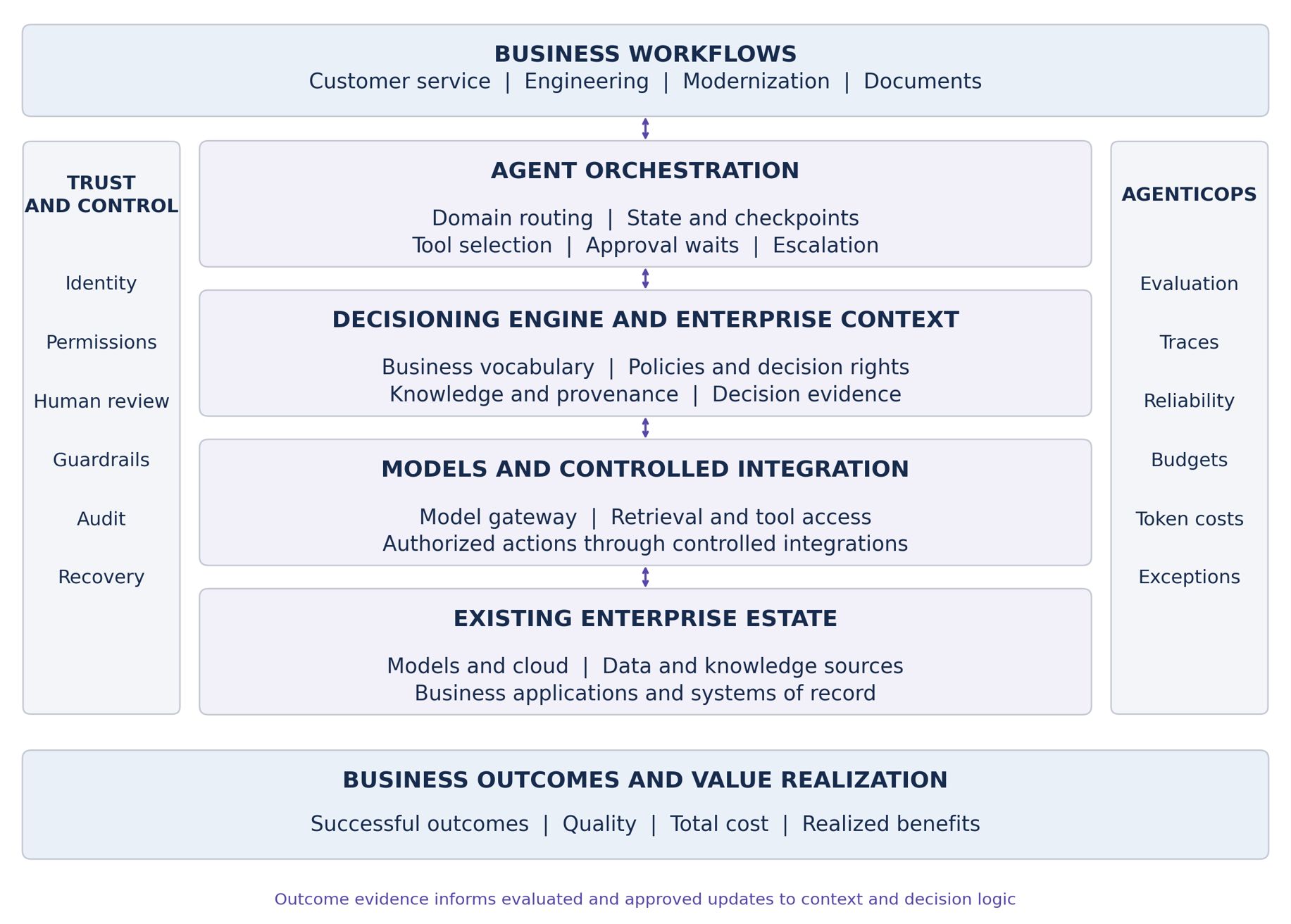
Figure 1. Logical architecture linking governed execution to enterprise AI value
For a service request, orchestration gathers approved context and policy, invokes the required model or tool, and routes changes through an authorized integration. People review exceptions and consequential actions where policy requires approval. Systems of record remain authoritative.
Capture cost, quality, and outcomes for each workflow, including model usage, tools, retries, and human review. Use the evidence to evaluate proposed improvements and decide whether to expand autonomy.
An AI Implementation Strategy for the First 90 Days
The following 90-day sequence is an illustrative starting point. Its purpose is to produce an investment decision supported by operating evidence. Delivery timing depends on data access, integration complexity, and assurance requirements.
|
Period |
Work to complete |
Decision evidence |
|
Days 1 to 30 |
Select one bounded workflow; establish baseline; confirm data and approvals |
Business owner, financial hypothesis, quality criteria and cost model |
|
Days 31 to 60 |
Build the integration; evaluate representative cases; run a limited comparison |
Outcome quality, exception rate, review effort and unit cost |
|
Days 61 to 90 |
Run controlled production; validate benefits with finance; reassess scope |
Observed business benefit and a decision to scale, revise or stop |
Apply the framework to industry value streams
In banking, suitable starting points include service-request triage, onboarding document preparation and policy guidance. Measure the time and cost of resolving a request, while preserving the approval boundary for consequential account or payment actions.
In insurance, claims-document intake, evidence extraction, and correspondence preparation offer bounded opportunities. Track completeness, correction effort, and claim-cycle time. Decisions that affect coverage or settlement require controls appropriate to the product and operating jurisdiction.
In travel and hospitality, disruption assistance and booking support should be assessed through successful rebooking, handling cost, and customer outcomes. In healthcare administration, benefit explanations and service navigation should preserve appropriate escalation to qualified staff.
Make the scale decision explicit
An initiative should move forward when the business can show acceptable quality, viable unit economics, and a credible realization path. If the economics rely on capacity release, identify the work that will absorb it. If they rely on conversion, use a controlled test where feasible.
Measurement remains a practical gap. Thomson Reuters’ 2026 professional-services study reports that only 18% of respondents said their organizations track AI ROI, while 40% did not know whether it was measured. Its sample spans more than 1,500 professionals.
The Coforge Perspective: Turning Enterprise AI Investment Into Business Value
Enterprise AI investment connects a business outcome to the context, controls, and operating cost needed to deliver it reliably.
This approach is consistent with Coforge’s published AI eXtended Enterprise Architecture perspective, which connects strategic outcomes, reusable architecture and governance. Coforge’s current AI capability positioning similarly emphasizes business architecture, domain context and a governed technical foundation.
Coforge Nuuron and the economics of enterprise autonomy
Coforge Nuuron is a composable enterprise autonomy enablement suite that connects enterprise knowledge, business context, decisions, and actions. It helps teams put agents into production around existing enterprise systems and workflows.
Start with a defined workflow such as know-your-customer (KYC) review, claims triage, or payment exception handling. Agree on the baseline, decision rights, and success criteria before deployment.
Coforge’s Decisioning Engine combines domain knowledge, policy checks, and outcome feedback. EvolveOps.AI provides the AgenticOps layer within Nuuron, with continuous evaluation, drift detection, and token monitoring.
In a bank’s KYC workflow, an agent could prepare evidence and route exceptions to an analyst. Approved customer context and integrations may also support periodic reviews. Validate each new workflow’s controls and incremental cost before expanding it.
Momentuum blue embeds Forward Deployed Engineers with client teams to configure and validate the initial workflow. Mod Squads help scale delivery with people and agents. Track cost per successful outcome, review and exception effort, realized savings, and the cost of adding the next workflow.
Translate spending into an operating capability
Business leaders own outcomes and process change. Finance validates baselines and realized benefits. Engineering maintains integration, evaluations, and cost visibility. Risk and security define the boundaries of approval and execution.
A delivery partner should leave the client with a working capability, a measurable baseline, and evidence for the scale decision.
Conclusion
Assess AI spending against work that meets an agreed quality standard. Value capacity released, realized savings, and incremental margin, depending on how each benefit reaches the business.
Fund the next deployment when the operating evidence supports its quality, cost, and financial case.
Start the conversation
Explore how Coforge can help assess an AI investment portfolio and engineer governed workflows tied to measurable business outcomes.
Visit www.coforge.com/capabilities/artificial-intelligence
FAQ
1. What are enterprise AI agents?
Enterprise AI agents use models, company context, and controlled tools to perform steps toward business objectives. Unlike simple assistants that primarily retrieve or prepare information, agents can coordinate workflows and execute bounded actions. Their autonomy should depend on evidence quality, reversibility, business risk, and appropriate human approval.
2. How should companies measure ROI from enterprise AI agents?
Start with a financial and operational baseline, then compare realized benefits with total AI costs. Include implementation, model runtime, integration, evaluation, human review, retries, and exception handling. Released employee time should not automatically be treated as financial savings unless costs fall or that capacity produces measurable additional value.
3. What should an AI budget include?
An enterprise AI budget should extend beyond model access. It should account for application engineering, enterprise-data preparation, system integration, evaluation, security, infrastructure, operations, human review, adoption, and change management. Measuring the total cost per successful business outcome gives leaders a clearer investment basis than model or token costs alone.
4. What is an AI operating model?
An AI operating model defines how business, finance, engineering, risk, and security jointly manage AI in production. It establishes ownership, approval boundaries, evaluation standards, cost visibility, and escalation paths. A strong operating model connects technical performance to the business outcomes and financial benefits expected from each AI deployment.
5. How can companies control AI agent costs?
Measure cost per accepted business outcome rather than token price alone. Track model calls, retrieval, tools, retries, human review, and downstream correction. Teams can then choose smaller models for straightforward tasks and stronger models where higher accuracy reduces failures, review effort, or expensive exceptions.
