





Coforge NEXA Agentic AITM, built on Coforge Nuuron blueprints and enterprise intelligence guidelines
In Specialty and commercial insurance, the first credible quote usually wins the risk. This paper sets out how carriers turn the submission inbox - today's slowest, least governed step in underwriting - into the fastest part of the value chain, in minutes rather than transformation cycles.
Executive Summary
Underwriting begins with a submission, and for most carriers, that is exactly where the value starts leaking. Broker submissions arrive fragmented across email, ACORD forms, portals, slips, SOVs, and bordereaux, and skilled underwriters spend their day sorting data rather than assessing risk. The cost is rarely captured on a single line of the P&L, but it is visible everywhere: slower quote-to-bind cycles, late-stage requests for information that irritate brokers, capacity consumed by administration, and good risks that competitors quote first.
The Coforge AI-Enabled Submission Center addresses that problem at the point of arrival. It is a productized, agentic AI capability that ingests every submission from every channel and automatically delivers clean, validated, enriched, and routed data to the right underwriter. Six coordinated AI agents share a common context and an insurance knowledge graph, operating under human-in-the-loop controls with a complete audit trail for every extraction and routing decision.
Carriers deploying the Submission Center target a 30 to 50 percent faster submission turnaround, an automated intake rate above 95 percent, data extraction accuracy of 99.99 percent, and an underwriting productivity uplift approaching 70 percent. Those outcomes are not the product of a bespoke build.
What follows is the market problem, the capability, the architecture that makes it trustworthy at enterprise scale, and the delivery model that converts it into measurable business outcomes
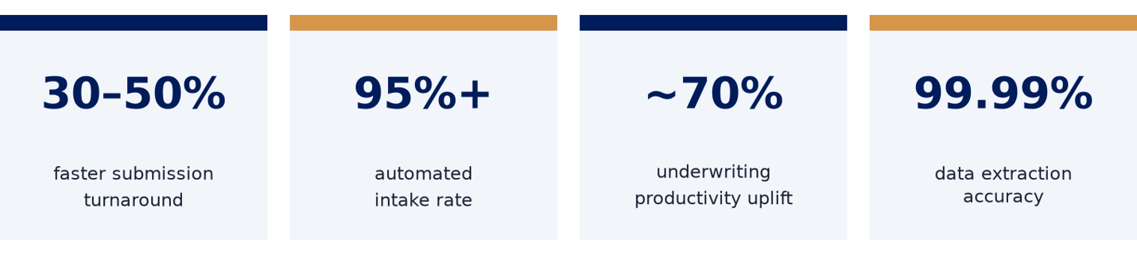
Figure 1. Target outcomes carriers underwrite the business case against.
The Market Challenge
Submissions are the fastest-moving asset in an insurance business, and most carriers are processing them at a walking pace. The volume of inbound risk has grown, the formats have multiplied, and the underwriting talent available to triage has not expanded to match. Five structural problems occur across P&C and Specialty carriers, syndicates, and MGAs, and they compound one another.
- Intake is fragmented. Submissions arrive as emails, ACORD forms, slips, bordereaux, etc., spread across email, broker portals, and EDI, with no unified structure to receive them.
- Manual triage caps capacity; heavy human effort goes into sorting, classifying, and routing,
- Underwriters are buried in administration rather than underwriting.
- Data quality gaps compound the problem, because incomplete submissions force late-stage requests for information
- Slow quote-to-bind erodes the broker’s experience.
The consequences follow quickly. Backlogs build, brokers face delays, underwriters miss opportunities, and competitors win the risk. And because manual workflows leave no clear audit trail, carriers cannot reliably track submission status, measure intake performance, or evidence regulatory compliance when asked to. Brokers notice all this long before a carrier does: submission share quietly migrates to whoever answers first, and it rarely migrates back.
The Submission Center: An Intelligent Front Door
The Coforge AI-Enabled Submission Center is an underwriting intelligence capability purpose-built for P&C and Specialty insurance. It sits at the point where submissions arrive and turns an unstructured, multi-channel stream into a clean, prioritized, decision-ready queue. Every submission, regardless of format or channel, is ingested, classified, extracted, validated, enriched, and routed with complete, audit-ready data from the first touch.
Four capability groups define what it does.
- Intake and classification provide a unified front door across email, portal, API, and EDI, with AI classifying document type, line of business, and priority on arrival.
- Extraction and validation apply natural language processing, computer vision, and structured parsers to pull every field, with a rules engine validating completeness instantly.
- Requests for information and enrichment remove the data-chasing burden: gaps automatically trigger structured broker RFIs, while third-party enrichment, such as geocoding and registry data, is appended without human intervention.
- Scoring and routing, then apply multi-factor risk scoring and workload balancing to place each submission on the right desk.
The capability is built on open, insurance-native foundations: agentic AI orchestration using Model Context Protocol and Agent-to-Agent protocols, natural language and large language models, computer vision, and ACORD standards throughout. Nothing here asks a carrier to abandon the standards its brokers and reinsurers already work to.
Inside the Agent Chain
The Submission Center is not a single model applied to a document queue; it is a chain of specialized agents that pass shared context forward, so that each stage understands what the previous stage established.
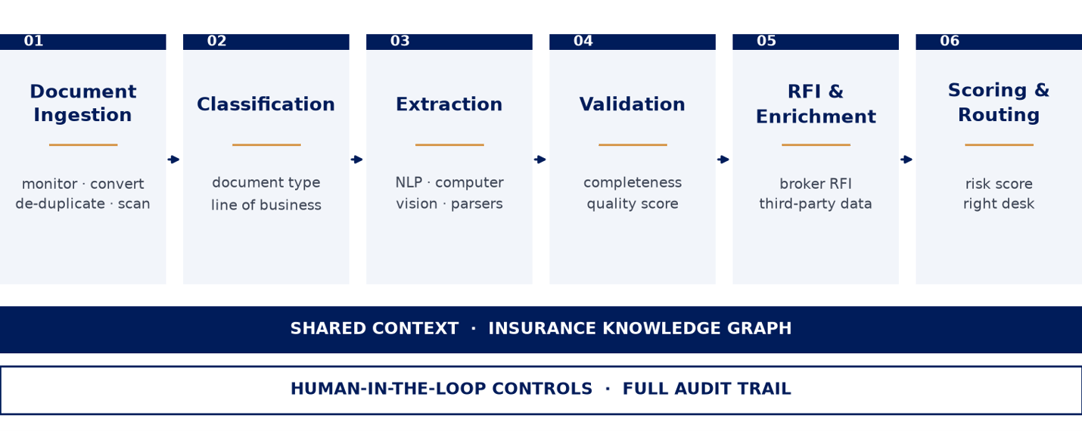
Figure 2. Six coordinated agents move every submission from arrival to the right underwriter's desk.
The Document Ingestion Agent monitors all channels, then converts, de-duplicates, virus-scans, and registers every submission that arrives. The Classification Agent applies fine-tuned transformers to assign document types and line-of-business taxonomies, thereby building a structured submission index. The Extraction and Validation Agents work in sequence, using natural language processing and computer vision to extract every field before a rules engine validates completeness and assigns a quality score.
Where data is missing, the RFI and Enrichment Agent automatically generates a structured broker request, triggers third-party enrichment, and re-runs extraction when the response arrives, closing the loop without an underwriter having to chase it. Finally, the Scoring and Routing Agent applies multi-factor scoring and routes the submission to the right underwriter, with notifications and a full audit trail attached.
Governance is not a layer bolted on at the end. Every field extracted is explainable, every routing decision is traceable, and every action is logged. That is what enables the capability to move from a contained pilot into production across an underwriting operation, and what allows a chief underwriting officer to widen their authority with confidence rather than hope.
The Business Case
The Submission Center is built around five business objectives, each with a measurable target. The value is not automation for its own sake; it is capacity released, cycle time compressed, and premium protected.
| Business objective | What changes | Target outcome |
|---|---|---|
| Speed to decision | End-to-end automation of the intake-to-routing cycle | 30–50% faster submission turnaround |
| Capacity without headcount | Underwriters judge risk instead of re-keying data | ~70% underwriting productivity uplift |
| Clean data, first touch | Validation and enrichment applied at the point of arrival | 99.99% data extraction accuracy |
| Automated intake | Unified ingestion across email, portal, API, and EDI | 95%+ automated intake rate |
| Reduced manual effort | Appetite-aligned routing and auto-generated broker RFIs | 25–40% reduction in manual handling |
Speed to decision compresses the quote-to-bind cycle through end-to-end automation, which matters most in Specialty and London Market business, where the first credible quote frequently wins the risk. Capacity without headcount means the same underwriting team absorbs more submissions, because underwriters exercise judgment rather than re-keying data. Clean data at first touch removes the late-stage surprises that stall binding, and appetite-aligned routing directs each risk by line of business, renewal status, and revenue potential rather than by whoever opens the email first.
Full auditability makes every AI decision logged, explainable, and defensible to a regulator or an internal model-risk committee. For a CFO, the arithmetic is unusually clean: the capability is funded by capacity it releases in the first lines it touches, and every subsequent line of business inherits the same agents at a fraction of the original cost.
Nexa is built on Coforge Nuuron blueprints and enterprise intelligence guidelines.
The Submission Center is not a standalone asset. It is one of the NEXA Products within the Coforge NEXA Agentic AI platform, the insurance-specific expression of enterprise intelligence that brings agents, an insurance knowledge graph, and proven industry archetypes to the decisions that matter most to carriers. NEXA delivers through a portfolio of more than 30 insurance-specific agentic assets, over 20 of which are already in production across underwriting intelligence, claims and fraud analytics, product and policy AI, distribution AI, and risk and compliance.
NEXA works alongside existing core platforms rather than replacing them, introducing an enterprise intelligence layer above and alongside the core that connects business context, decision intelligence, workflow, and autonomous action across the insurance value chain. Beneath NEXA sits Coforge Nuuron, the Enterprise AI Operating System that makes carrier-facing intelligence trusted, governed, and repeatable.
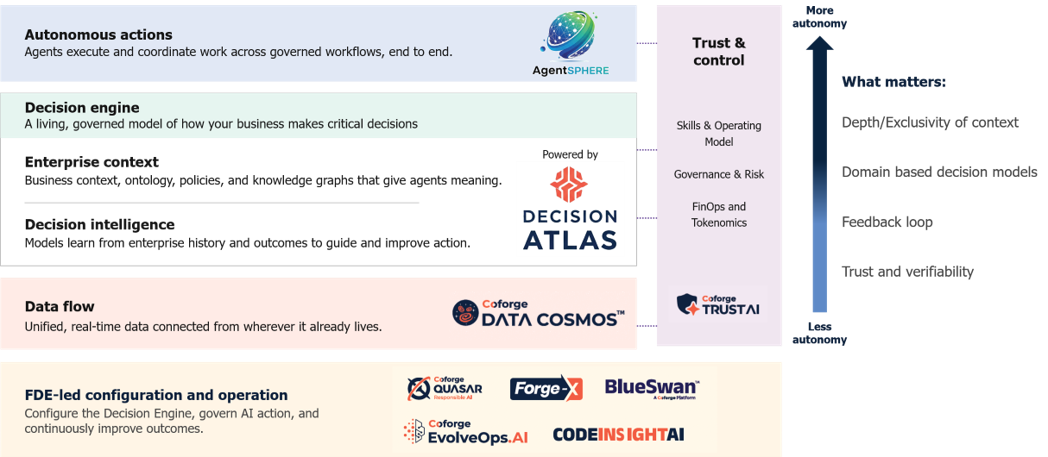
Figure 3. NEXA Products run on Coforge Nuuron and sit above the core,with trust and control running through every layer rather than beside them.
Coforge Nuuron is built on four connected capabilities. Data flow supplies the real-time enterprise data, operational workflows, and transactional context required to orchestrate intelligent processes. Enterprise context provides insurance ontologies, business context, and knowledge graphs that can be reused across products and business units. Decision intelligence combines business rules, decision models, and AI to deliver contextual recommendations. Autonomous actions allow AI agents to execute operational activity across business and technology functions under appropriate governance. Trust and control run through all four rather than beside them, through audit-ready design, human-in-the-loop controls, decision traceability, and input-output guardrails.
The Submission Center, therefore, carries compounding value. Knowledge captured during deployment - product taxonomies, underwriting rules, broker document patterns - enters a reusable knowledge layer that shortens the next deployment. Archetypes are versioned, owned, and improved like products, so each implementation strengthens the one that follows instead of starting from a blank page. The second line of business is always faster than the first.
Delivered as a Product, not a Project
The Submission Center is brought to life through Momentuum blue, Coforge’s specialized operating unit consisting of Forward Deployed Engineers, through which Coforge shapes clients’ solutions by defining the target outcome, appetite, taxonomy, and broker mix. The execution is carried out by Mod Squads: cross-functional Forward Deployment Engineering teams augmented by AI agents, delivering across product engineering, core platform integration, data, and quality engineering as a single, accountable unit.
Because the agents, connectors, and workflows are prebuilt and configurable rather than bespoke, deployment takes weeks rather than transformation cycles. Each NEXA Product carries a defined business outcome and an accountable owner, and every deployment is instrumented against business KPIs so that value realization is measured rather than asserted.
Commercially, this supports engagement models tied to outcomes - underwriting capacity created, submission-to-bind improvement, straight-through processing rates - rather than effort consumed. Carriers buy a result, and the evidence for it arrives on the same dashboard as the result.
NEXA Submission Center Commercial Model
NEXA Submission Center follows a simple, scalable commercial model that provides predictable platform costs while enabling clients to scale seamlessly as submission volumes grow. The commercial model comprises a one-time configuration fee covering environment setup, security, SSO, and core integrations, along with a recurring enterprise platform fee that supports unlimited users and continuous platform enhancements. In addition, a usage-based charge applies for each submission processed across the end-to-end submission workflow. NEXA can be deployed in either a Coforge-hosted or client-hosted environment, with commercial terms tailored based on hosting preferences, integration requirements, transaction volumes, token consumption, and the number of lines of business onboarded.
Why Coforge
Coforge's insurance practice brings more than two decades of industry expertise, powering transformation for over 80 insurers globally with a fully industry-certified talent base across P&C, Life, and Specialty lines. That depth is matched by proven delivery across leading core platforms, including Duck Creek, Guidewire, Sapiens, and Majesco, which enables an intelligence layer to be introduced without disrupting the systems of record beneath it.
Coforge is an AI-native engineering services leader, with AI as the foundation for how solutions are designed, built, and delivered. The firm combines AI agents with an AI-enabled workforce, including specialized forward-deployed engineers working in pod-based delivery units, and maintains a deep focus on trusted AI to ensure solutions are secure, governed, and enterprise-grade.
The orientation is outcome-led by design: moving beyond AI experimentation to deliver lower operating costs, faster cycle times, higher conversion rates, and sustained margin growth.
Turning Intake into Advantage
Submissions are where underwriting either accelerates or stalls. Carriers that industrialize the intake layer convert the same underwriting talent into more quoted risk, faster, with cleaner data and a defensible audit trail behind every decision. Those that do not will continue to lose good risks to competitors who simply answered first. The Coforge AI-Enabled Submission Center makes that shift practical: pre-built, governed, insurance-native, and live in weeks.
Turning intake into advantage. Win the risk before your competitors see it.
Coforge NEXA Agentic AITM - Enterprise Intelligence for insurance, built on Coforge Nuuron blueprints and enterprise intelligence guidelines
About the Author