





Fraudulent insurance claims are among the biggest preventable losses affecting insurers worldwide. The P&C segment accounts for the most fraudulent insurance claims, with auto insurance and workers’ compensation making up the largest share of these claims, which annually affect the insurance business.
Traditionally, insurers have detected fraud manually. Due to the inherent drawbacks of these techniques, undetected fraud continues to strain insurers. Since this method relies on existing fraud data, new fraud could also easily go unnoticed. Some fraudulent claims slip through the system when only sampling methods are used to detect them. In addition, the old approach is not designed to handle the influx of data and information from numerous new sources in an integrated way, as it operates in silos.
What is Insurance Fraud?
When an insurance firm, agent, adjuster, or customer intentionally lies to get an unfair advantage, then insurance fraud occurs. It can happen when purchasing, utilizing, reselling, or underwriting insurance. Insurance fraud can be classified into various subcategories, including fraud committed by consumers and insurance firms. Fraud affects consumers and businesses financially and adds to insurance companies’ costs.
All insurance industries, including medical, auto, and home insurance, are rife with fraud. Even today’s most well-known insurance firms understand that insurance fraud occurs, but they sometimes lack the resources to identify and investigate all potentially fraudulent claims.
Claim fraud is the most common form of insurance fraud. Organizations that manually file claims are frequently left unequipped as fraudsters’ tactics become more complex and firms lack the technical capacity to keep up, whether it be an individual making an overstated claim or a coordinated conspiracy among many to exploit insurance companies. Insurance claim fraud is not new, but it has always proven challenging to eradicate.
Insurance Fraud Types
Here are two major insurance fraud types:
- Hard fraud is the act of deliberately faking injury or damage to get money from an insurance company.
- Soft fraud involves exaggerating the damage caused by a real accident to get more money from the claim.
More specifically, these are some of the most common insurance fraud types split by niche:
- Workers’ Compensation Benefit fraud: Fakes an injury at work to get paid time off, claims an injury occurred on the job when it took place elsewhere, etc.
- Property insurance fraud:False or inflated property damage, false or inflated burglary or theft report, arson, intentional damage claim, etc.
- Auto insurance fraud: False repair claim, staged accident, intentional damage claim, auto shop scam, falsifying the date or details of an accident, etc.
- Disability and healthcare fraud: Includes billing for services that were not provided, falsifying documents to bill for a more expensive service than what was actually provided, falsifying documents to obtain and bill for unnecessary services, double-billing, falsifying disability claims, submitting forged documents to continue a disability claim, and so on.
Benefits of Insurance Fraud Detection by using AI
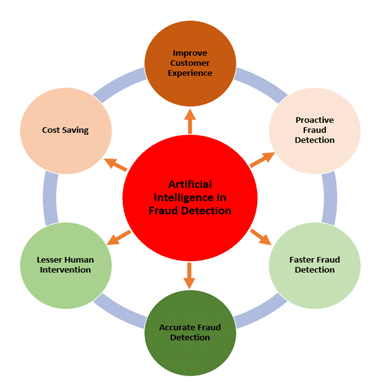
- Proactive fraud detection
Predictive analytics creates more opportunities for proactive fraud detection initiatives. Today’s organized, digital frauds require advanced data mining, analytics, and customized algorithms that model fraudster behavioral patterns to enable proactive, timely scam detection.
The technology identifies the root causes of fraudulent activity and uses data to predict and proactively combat it. - Faster fraud detection
AI technology not only automates fraud detection but also identifies fraud patterns, enabling early flagging and a prompt response to potential incidents.
As the number of clients increases, claims adjusters are under greater pressure and must either sacrifice accuracy or speed in the claims process. On the contrary, the more data machine learning algorithms receive, the faster they provide accurate results. - Accurate fraud detection
Next, predictive analytics delivers results that are far more accurate than a human agent can. As a result of processing big data, digital tools have access to more information, enabling them to make decisions with never-before-seen accuracy. - Lesser human interventions
By leveraging technology and data analytics, insurers reduce the need for manual interventions in the claim management process. This reduces turnaround times and frees up insurance agents to focus on more valuable, high-impact tasks. - Cost savings
With more accurate fraud detection and fewer false positives enabled by AI technologies, insurers can significantly reduce financial losses. Also, by automating repetitive processes like fraud detection, you won’t need to increase your headcount as you scale up, which otherwise would have come with extra costs. - Improved customer experience
All things considered, automated insurance fraud detection powered by AI and big data allows insurers to reduce costs and offer more competitive insurance plans to customers.
Leveraging Artificial Intelligence for Insurance Claim Fraud Detection
One of the top priorities for insurers in insurance claims is identifying and stopping fraudulent claims as quickly and effectively as possible. Reducing client premium costs can result from preventing fraudulent claims, benefiting an insurance company’s bottom line and performance. AI has the potential to change this situation. Information systems have undergone significant change thanks to AI technologies, which have made them more user-friendly and straightforward.
The use of AI in claims fraud detection is highly effective, improving customer satisfaction and saving businesses money.
In the millions of insurance claims that businesses receive each year, machine learning and AI algorithms can quickly identify patterns, enabling them to spot outliers and dubious requests in real time.
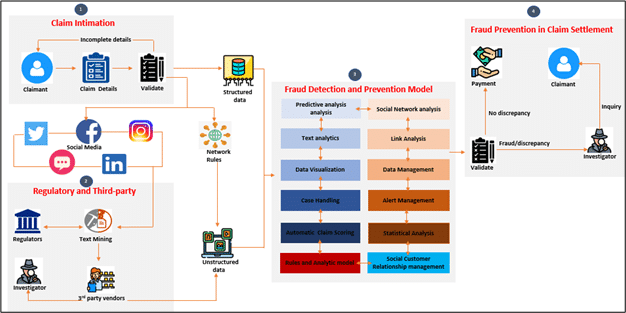
Claim Fraud detection and prevention model
Predictive Analytics for Insurance Fraud Prevention
Predictive analytics for early identification and fraud prevention is the first line of defense against fraudulent insurance claims. Predictive analytics may evaluate a policyholder’s fraud risk and provide early warnings of potentially fraudulent activities based on their profile and behavior patterns at each new customer touchpoint and as more information is collected.
When using AI for claim fraud detection, algorithms accurately assess each claim and assign a reason code, which can help identify whether the request is suspicious and warrants further review. Insurance companies can better allocate resources to investigate claims flagged as possibly fraudulent, saving time and money by warning personnel about potentially fraudulent claims before processing and payouts.
Use of Predictive analytics in Claim, Pricing, and New Product design
Fraud prevention helps insurers prevent fraud at various stages of the insurance cycle, including applications, premiums, and claims. It provides access to public records, such as criminal records, medical histories, and bankruptcy declarations, to review for inconsistencies and prevent fraud.Pricing and risk mitigation offer insights that facilitate decision-making and estimate the level of risk that the insurance company must assume while calculating the premium. For instance, those who go to the gym regularly may be eligible for a discount on health insurance.
Pricing and risk mitigation offer insights that facilitate decision-making and estimate the level of risk that the insurance company must assume while calculating the premium. For instance, those who go to the gym regularly may be eligible for a discount on health insurance.
Trends tracking helps insurers create new products, design new customer experiences, and deploy new technologies by monitoring what’s trending in the insurance world. This also gives insurance companies a competitive edge.
1. Text Analytics and Data Mining
With these cutting-edge capabilities, AI is streamlining the entire insurance claims process and enabling businesses to implement more intelligent fraud detection without additional staff or costs. Utilizing AI for claims fraud detection enables businesses to quickly evaluate structured and unstructured data from internal and external sources, improving analytics and enhancing firm protection. The more policyholder data that can be accessed and analyzed, the better organizations can assess the likelihood of fraudulent insurance claims.
Data from insurance applications or claim forms may be mined by insurance companies using AI. Insurance adjusters typically examine property damage or personal injury claims to assess the reimbursement to policyholders. These adjusters frequently take notes during their assessments. These remarks are frequently handwritten, so they aren’t organized. By identifying red flags in adjuster notes, natural language processing (NLP) could help insurers spot potentially fraudulent claims.
2. Real-Time Monitoring and Notification
The ability to analyze data quickly and in real time is one of the biggest USPs of insurance fraud detection using machine learning and artificial intelligence. As a result, insurance companies invest more time in preventing fraud than in recovering from it. Businesses can respond promptly to events and minimize losses thanks to real-time event flagging and reporting.
The routines and behaviors of claimants and policyholders are continuously monitored by AI systems. The algorithms can instantly spot potentially fraudulent behavior and immediately notify the business when a claim requires further examination.
Insurance companies can use AI to better defend against claims fraud and related losses by leveraging NLP to analyze historical claims data, enhanced data mining, real-time alerts, and improved early fraud risk detection.
Conclusion
Insurance fraud puts insurance firms at grave financial risk. Thus, they should take proactive steps to improve their fraud-prevention measures. Predictive analytics, AI, and machine learning are currently being rapidly embraced in the insurance sector, aiding insurers in their whole business transformation. Artificial intelligence will go a long way toward making the insurance claim settlement process less laborious and more interactive. Additionally, automating the insurance claims process frees up human resources for tasks other than reviewing paperwork. Because these new technologies help insurance companies stop fraud leaks in the claims area, they provide a significant return on investment in fraud analytics.
Coforge supports global insurers on their digital transformation journey, helping them deliver an improved customer experience and gain a competitive advantage. Our customized insurance testing services span Life Insurance (Life, Annuity, and Pension), Property & Casualty (P&C), Auto, and Reinsurance.
We ensure your apps and systems run seamlessly by ensuring efficient back-office operations. Our testing services portfolio and unmatched track record make us a trusted advisor and preferred technology partner for insurance clients.