





AI Summary
Key points of this article, generated by AI.
Generating AI Summary
You are interacting with an AI system. AI-generated responses may not always be accurate or complete. Please verify important information before relying on it.
Immersive commerce uses technologies like AR, VR, 3D visualization and generative AI to digitally recreate the in-store shopping experience, giving customers confidence that traditional online retail lacks. By enabling real-time product interactions, virtual try-ons and personalized recommendations, it improves conversion rates, reduces returns, and increases customer engagement compared to traditional eCommerce.
The Shortcomings of Traditional eCommerce
eCommerce has fundamentally reshaped retail, bringing speed and convenience to millions of shoppers worldwide. Yet despite decades of optimization, the online journey still falls short of replicating the in-store confidence that comes from trying, touching, and comparing products physically.
Customers must rely on static images, reviews, and assumptions about quality or fit, which often leads to disappointment and higher return rates. This lack of sensory engagement represents a major friction point for digital retail - increases costs for returns, and limits brand differentiation in highly competitive markets.
How Immersive Experience Differs from Traditional Online Shopping
Traditional digital commerce provides limited interaction and leaves customers uncertain until products arrive, while immersive commerce bridges this gap by enabling visualization, simulation, and guided interaction in real time.
Customers can not only view products but also test how they fit into their lives, whether that means virtually placing a sofa in a living room, trying on a jacket with accurate drape simulation, or receiving personalized guidance for an upcoming event.
|
Traditional eCommerce |
Immersive Commerce |
|
Static product photos and text |
Interactive 3D models, AR/VR, and try-ons with true-to-life fit and texture |
|
Generic browsing and filtering |
Conversational AI stylists and context-aware personalization |
|
Feedback delayed until delivery |
Real-time previews, simulations, and interactive recommendations |
|
Uniform interfaces for all users |
Experiences tailored by persona, purchase history, and behavioral context |
For business leaders, adopting immersive commerce is not only a customer-experience upgrade. It’s a way to differentiate and compete as an innovation-driven brand. Retailers that adopt immersive commerce early are also more likely to capture younger demographics (particularly Gen Z and Gen Alpha) who expect digital experiences to be social, interactive, and immersive.
Examples of Immersive AI Offerings
Immersive AI is no longer experimental; it is already redefining customer engagement:
- Virtual Try-On: Customers can preview apparel, cosmetics, or furniture in their own context before purchasing, reducing uncertainty and fit-related returns. Research from Shopify indicates AR product visualization can increase conversions by as much as 94%, and virtual try-ons lead to fewer returns.
- AI Stylist Chatbots: Intelligent agents combine purchase history, trend data, and real-time context to deliver dynamic recommendations. Brands implementing conversational AI see conversion rates increase by up to 4×, and shopping sessions speed up by nearly 50% when customers interact with AI chat.
- Visual Similarity & “Complete-the-Look” Search: Shoppers upload an image or select a product to find stylistically similar items or complementary pieces. Amazon’s personalization solutions reduce bounce rates significantly. For fashion, beauty, and home décor, similarity search transforms inspiration into conversion by connecting desire with available inventory.
- Immersive Environments & Social Commerce: Platforms like Roblox allow brands to build immersive showrooms where users can explore, co-create, and even purchase physical products. These spaces are not limited to marketing. They are becoming new points of sale, allowing retail to intersect with gaming, events, and culture.
- Application Hosting & Security: The application runs on AWS Fargate (ECS), served through Amazon CloudFront and secured with AWS WAF (Web Application Firewall). Users authenticate with Amazon Cognito user pools. Secrets Manager stores API keys, URLs, and Cognito IDs securely. This ensures apps are distributed globally, load quickly, and remain hardened against threats.
- API Gateway & Routing: API Gateway exposes endpoints, routing traffic from users to the correct AWS Lambda functions. Routes include /text for chat, /image for try-on, and /search for product discovery. Gateway integration simplifies scaling and monitoring, while Secrets Manager integration enforces secure access.
- Catalog & Image Pipelines: Uploading catalog files to S3 invokes a Lambda that ingests documents into Bedrock knowledge bases, updating vector indexes in Amazon OpenSearch Serverless. Uploading product images triggers Titan Embedding pipelines to generate embeddings stored in Amazon DynamoDB or, at production scale, Amazon OpenSearch Serverless. These pipelines keep catalogs fresh, synchronized, and fully searchable.
- Multimodal Understanding (Lite, Pro, Premier): Process text, image, and video for contextual queries, enabling multimodal recommendations.
- Creative Models (Canvas, Reel): Generate imagery and video such as composites or reels, powering campaigns and social experiences.
- Retrieval-Augmented Generation (RAG): Ground responses in live product and inventory data
- Advanced Features: Handle multimodal queries (e.g., “show me items like this photo”) and enable browser-agent extensions.
Collectively, these examples show how immersive AI directly impacts conversion, loyalty, and brand differentiation. They demonstrate that immersive retail is not a passing trend, but a structural shift in how consumers expect to interact with brands.
AWS Architecture for Immersive Commerce
To realize immersive experiences, AWS provides a reference blueprint built for scalability, security, and agility.
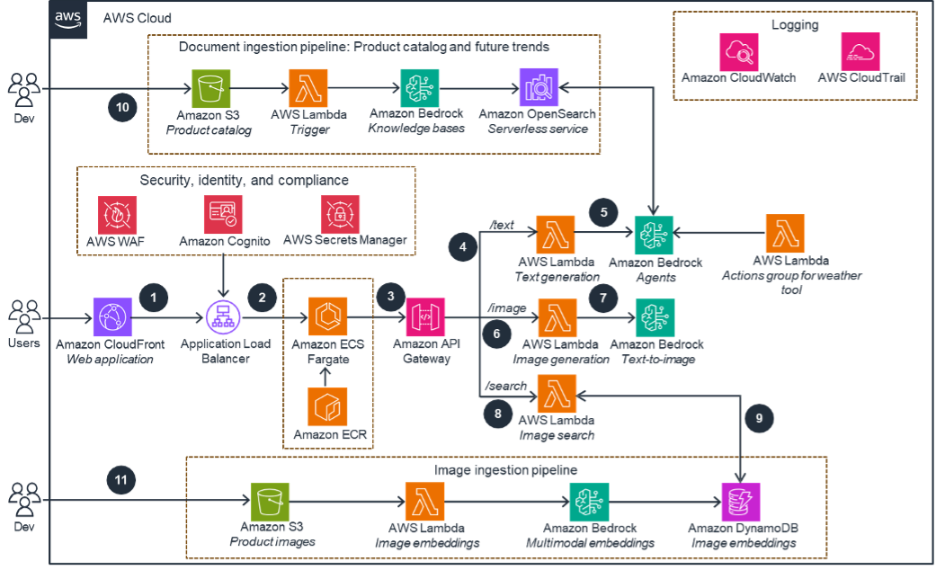
Architecture Diagram: Virtual Personal Stylist on AWS
-
Application Hosting & Security: The application runs on AWS Fargate (ECS), served through Amazon CloudFront and secured with AWS WAF (Web Application Firewall). Users authenticate with Amazon Cognito user pools. Secrets Manager stores API keys, URLs, and Cognito IDs securely. This ensures apps are distributed globally, load quickly, and remain hardened against threats.
-
API Gateway & Routing: API Gateway exposes endpoints, routing traffic from users to the correct AWS Lambda functions. Routes include /text for chat, /image for try-on, and /search for product discovery. Gateway integration simplifies scaling and monitoring, while Secrets Manager integration enforces secure access.
|
Text Generation Flow
|
The /text endpoint invokes a Lambda that calls Agents for Amazon Bedrock. The agent considers user context, such as location and weather, and queries data stored in S3 and indexed in Amazon OpenSearch Serverless knowledge bases. The response includes grounded style recommendations, preventing hallucination and ensuring outputs align with brand data. |
|
Image Generation Flow
|
The /image endpoint triggers a Lambda that calls Bedrock’s image generation model. The model returns a Base64-encoded result to API Gateway, which delivers the try-on image to the end user. This provides fast, interactive results for shoppers experimenting with looks and items. |
|
Visual Search Flow |
The /search endpoint activates a Lambda that creates query embeddings and matches them against embeddings in Amazon DynamoDB using cosine similarity. Uploading new images to S3 automatically triggers a Lambda that uses Titan Multimodal Embeddings to update Amazon DynamoDB. Top matches are returned instantly to the user interface, providing seamless visual discovery. |
This design supports multiple immersive features simultaneously. By incorporating Amazon Nova foundational models, retailers extend capabilities with:
This blueprint demonstrates how AWS services interconnect to deliver immersive shopping experiences that are secure, responsive, and easily scalable. It is not just a technology solution, but an enabler of business transformation.
How to Move from Traditional to Immersive Commerce
Shifting to immersive commerce is a strategic initiative that requires experimentation, measurement, and scaling:
- Start with a Targeted Pilot: Choose categories where uncertainty is high, such as fashion or home furnishings, and deploy features like try-on or AI stylist. Early wins create internal momentum and deliver measurable ROI quickly.
- Leverage AWS GenAI Tools: Use Amazon Nova multimodal models coupled with RAG to ensure recommendations remain accurate, contextual, and aligned with live inventory. Nova reduces time-to-market by removing the need to train foundation models from scratch.
- Design for Scale and Security: Apply serverless design, encryption, moderation, and IAM best practices to meet compliance and performance standards. Align solutions with the AWS Well-Architected Framework for reliability.
- Iterate and Learn: Continuously track metrics like conversion uplift, engagement duration, and return-rate delta. Employ A/B testing to refine user experience and create a cycle of ongoing improvement.
- Integrate Omnichannel: Feed digital insights back into CRM systems and in-store experiences to create a seamless journey. In practice, this means a shopper who tries an item virtually receives consistent recommendations in marketing emails and at physical touchpoints.
Conclusion: Beginning the Immersive Commerce Journey
Immersive commerce is no longer optional; it is becoming a baseline expectation for digital-first consumers. The sooner retailers adopt, the sooner they shape experiences that set the standard for the next decade. Hesitation risks being left behind as competitors capture customer loyalty with immersive features.
A staged roadmap to adoption:
- Phase 1 (0–2 weeks): Identify categories and KPIs with highest impact. Focus on categories like apparel or furniture where fit and context matter most.
- Phase 2 (2–6 weeks): Deploy a pilot such as stylist chat or similarity search for limited products. Prove the concept and communicate results internally.
- Phase 3 (6–12 weeks): Add AI try-on, expand catalog integration, and measure outcomes at larger scale. Use analytics to validate ROI.
- Phase 4 (12+ weeks): Scale across categories, integrate with omnichannel strategies, and harness insights for product planning and marketing.
The future of retail will be defined by immersive experiences that combine creativity, intelligence, and trust. Those who start building now will set tomorrow’s standards in customer experience, operational excellence, and sustained business growth.
