





Why group installation and employer group enrollment are about to get harder, not easier
If you run operations for a health plan, you know that the real friction is not in the flashy parts of the business, but in case installation, employer group setup, and enrollment. Get it right and nobody notices. Get it wrong and it shows up everywhere: high call center volumes, delayed claims, or group renewals that don’t happen. That’s where contract-to-claim automation can pay dividends for healthcare payers.
The Numbers Behind the Problem
At Coforge, our experience working with healthcare payers has shown that configuring one employer group contract in the core admin system can take 80 to 100 hours on average, which is a recurring cost you pay every time a group is added or a plan year turns over. That’s part of why healthcare technology spend in the $145–155 million range has become a strategic lever rather than a back-office line item. It’s also why group enrollment shapes the operating economics of the $65–70 billion that payers outsource to healthcare IT services providers.
How the Group Installation and Enrollment Process Works
Once an employer group negotiates a contract that specifies which benefits are provided at what cost-per-share, that contract is then translated into system configuration: benefit codes, cost-sharing rules, network tiers. This is done largely by hand, one field at a time. This is case installation: 80–100 hours of fingers-on-keyboard work that is invisible to anyone outside operations. It's also where a single mistyped code or misread clause quietly enters the system, undetected until it resurfaces as a claim denial months later. It’s manual, repetitive, and foundational to everything downstream.
Once installed, employees choose a plan and are added as members as part of employer group enrollment. From there, the relationship runs on claims: a provider submits a claim, and the payer’s system checks eligibility and contract terms before paying or denying it. This is also where an installation mistake (made months earlier) can resurface as an incorrectly paid or denied claim.
Contract ⟶ Installation ⟶ Enrollment ⟶ Claims. That full chain is why the industry talks about “contract-to-claim” as one connected process, not four separate handoffs. It’s worth differentiating from similarly-named neighbors: provider credentialing (onboarding doctors into a network, not members into a plan), eligibility verification (real-time activity checks), and prior authorization (pre-approval for procedures).
Why the Current Model is Structurally Broken
- Cost pressure outpaces efficiency. Managing rising costs is the top challenge cited by health plan executives.
- Manual errors don’t stay contained. A misread contract clause at setup doesn’t surface until it’s a denied or mis-paid claim months later. By then it’s a member service issue and a configuration fix.
- Peak open enrollment exposes how thin the model is. What’s just a slow process in April becomes a genuine capacity constraint in Q4.
- Fragmented systems break the journey, not just the workflow. Contract terms, benefit configuration, eligibility, and claims logic live in different systems with different owners, nobody has a single view of a group’s install status.
- AI adoption in enrollment lags the rest of the CX conversation. Despite investments in digital member services, the operational backbone remains largely unmodernized.
- Manual data entry is still the default, not the exception. Contract terms and benefit configuration are not captured once and carried forward. They are largely re-keyed by hand at each stage: from contracting into the admin system, and again into downstream claims and eligibility platforms. This is the root cause behind nearly every other issue on this list.
These aren’t six separate problems. They are symptoms of one issue: a model built on manual translation between systems that were never designed to talk to each other.
How Changing Regulatory Requirements Raise the Stakes for Payers
The One Big Beautiful Bill Act (OBBBA), enacted in 2025, reshapes Medicaid eligibility in ways that touch this machinery directly. Starting in January 2027, most adults enrolled in Medicaid expansion plans face eligibility redeterminations every six months instead of annually, roughly doubling the verification frequency. Once you factor in state-level insurance regulation, a payer operating across a dozen states must comply with a dozen overlapping rulebooks, not one. This is a near-term increase in frequency and complexity for processes already under strain.
How to Close The Contract-to-Claim Gap
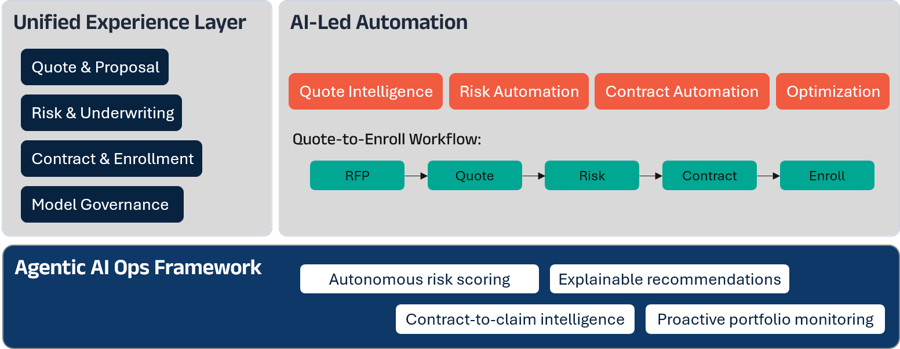
The industry’s response is converging on a single idea: Stop treating contract, installation, enrollment, and claims as four separate systems bridged by manual work, and start treating them as one connected intelligence layer. A group’s actual contracted terms travel from negotiation through configuration into claims validation. As a result, what gets built matches what was signed, and every downstream team inherits clarity instead of reconstructing intent from scratch.
That’s the problem that Coforge’s NuuCare – Quote to Enroll solution was built to solve for. The diagram below shows how it works in practice:
Key Takeaways for Payer Operations Leaders
- Treat enrollment as risk management, not just cost management. A misconfigured benefit is a future claims dispute or compliance exposure waiting to happen.
- The regulatory clock is accelerating, not resetting. Six-month redeterminations starting in 2027 mean the same infrastructure must run roughly twice as often.
- Fragmentation is the root cause, not the symptom. Point fixes keep missing each other as long as contract terms, configuration, and claims logic live in disconnected systems.
- Peak season is a stress test that your model may not pass. Six-month cycles will compress that strain into a recurring, year-round pattern.
- The AI gap in enrollment is an execution gap, not a strategy gap. The open question is whether your company’s AI commitment has reached the teams managing day-to-day installation and enrollment activities.
Schedule a Demo of Coforge NuuCare – Quote to Enroll
If you are ready to transform your group installation and employer group enrollment processes, we can put NuuCare – Quote to Enroll to work for you. Contact us to schedule a consultation with one of our experts.