




ServiceNow simplifies work processes by leveraging an AI-driven workflow engine, offering solutions tailored to IT, employees, and customers. Additionally, the Now Platform empowers users to create customized enterprise workflows as required. Nevertheless, the implementation of ServiceNow may pose challenges, especially for organizations that are new to the platform or lack sufficient IT expertise.
One of the biggest challenges of ServiceNow implementation is ensuring that the platform is configured to meet the organization’s specific needs. This involves understanding the organization’s business processes and workflows and customizing ServiceNow to automate and optimize these processes. This can be a time-consuming and complex process, particularly for organizations with complex IT environments or legacy systems that need to be integrated with ServiceNow.
The Coforge approach
In general, the implementation of ServiceNow presents a considerable challenge, demanding meticulous planning, expertise, and adequate resources. Nevertheless, by adopting a well-considered approach and availing themselves of Coforge's ServiceNow Center of Excellence (COE) support, organizations can effectively execute ServiceNow implementation and reap the rewards of streamlined IT operations and improved service delivery.
Let us examine some of the most common ServiceNow challenges while implementing and fully adopting ServiceNow as an IT service management (ITSM) solution.
- Internal Requests
- Over Customization
- Complicated Workflows and Outdated Processes
- Lack of Expertise
- Generic Training
- Resistance to Change
- Implementation costs
- Limited Integration Options
- Periodic Maintenance
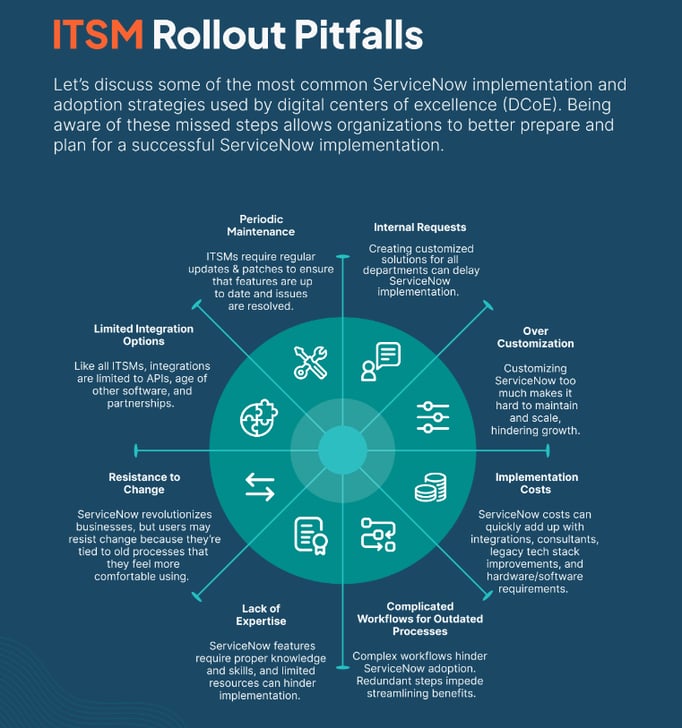
1. Internal Requests:
When you implement ServiceNow for one of the modules in a department, other departments raise requests for the implementation. Creating customized solutions for each department will delay your implementation. The whole purpose of using ServiceNow is to maintain a seamless flow of information across the teams.
If organizations start entertaining these requests and go off the track with their vision, it creates chaos and affects the whole implementation process.
Solution: Maintain a seamless flow of information across the teams and investigate overlay low-code software to speed up software change management.
2. Over Customization:
Excessive customization can make your ServiceNow installation difficult and expensive to maintain. Customizations can make expanding ServiceNow to new departments or organizational units challenging. It also makes updates to your system more time and labour-intensive as you must ensure your custom code will work with the latest version. Forty-two percent of consumers are annoyed when content isn’t personalized.
Solution: Prioritize features that meet business OKRs and digital transformation goals that affect revenue and business-critical processes.
3. Complicated Workflows & Outdated Processes:
The more complicated your workflows, the harder time you will have to adopt an ITSM solution like ServiceNow. ServiceNow is designed to streamline your processes, but you can only reap the benefits if you create simple workflows. You will also need to update and integrate your processes with all relevant data points.
Without proper integration, the data flow across the teams could be affected. If one of the systems is not integrated with the other, we might lose some valuable insights due to data silos. Ninety-four percent of corporate company executives would prefer to utilize a unified platform to integrate their apps and implement process automation than rely on several platforms.
Solution: Do not build ServiceNow to accommodate current outdated processes. Use it to improve and transform, even if that means changing business processes. Monitor and track processes post-implementation for data-informed process optimization solutions.
4. Lack of Expertise:
ServiceNow has a vast range of featured solutions for each IT, Employee, and Customer workflow. Having the right knowledge and skills to accommodate those features might lead to better execution. An organization’s resources may be limited due to the constraints on its activities.
Solution: Allocate resources for training to ensure smooth implementation without affecting ongoing projects.
5. Generic Training:
Generic ServiceNow training might not be tailored to your business and processes. Companies often make the mistake of training people on the software, but it is more appropriate to prepare the relevant team on how they can leverage the software to their advantage. .
Solution: Prepare teams on how to use the software to their advantage with personalized in-person and in-app training tailored to their job role and business use cases. Decrease digital friction with helpful self-paced guidance.
6. Resistance to Change
ServiceNow revolutionizes businesses, but users may resist change because they are tied to old processes that they feel more comfortable using. This resistance to change can be due to several factors.
First, employees may be comfortable with their existing system and may feel that ServiceNow is an unnecessary disruption to their established routine. Additionally, employees may be concerned about their ability to use the new platform effectively and may resist learning new processes or systems.
The implementation revamps the way a business operates.
- The transformation it brings to the IT experience,
- The automation it provides to the HR, and
- The acceleration to the security,
But the users are reluctant to change. Most of us cannot manage that much change in a shorter interval.
Solution: Create a digital adoption center of excellence (CoE) to include all stakeholders before implementation to evaluate and address company culture. A change management CoE can also help hereafter implementation.
7. Implementation costs
One of the significant challenges of ServiceNow is its implementation cost. ServiceNow is a complex platform that requires significant resources, time, and money investment. Organizations need highly skilled professionals to implement this platform successfully. Therefore, the implementation cost of ServiceNow can be a significant challenge for many organizations.
Solution: Purchase through a partner that includes consulting and implementing software add-ons that are known for their positive ROI and proven payback cycles.
8. Limited Integration Options
Another challenge organizations may face with ServiceNow is the limited integration options. ServiceNow offers integration with other tools and platforms but may only integrate with some of the tools and platforms an organization uses. This can disadvantage organizations that rely heavily on other tools and platforms.
Solution: Take full advantage of all the software features and functionality by looking for cloud-based application overlays that do not require immersive integrations to aid in your digital transformation goals.
9. Periodic Maintenance
ServiceNow is a highly customizable platform that requires regular maintenance. Organizations must keep their ServiceNow instance up-to-date and ensure the platform runs smoothly. This can challenge organizations that need more resources or expertise to maintain the platform regularly.
Solution: Look for software admin experts within your organization and externally to maintain the software effectively. This is where a CoE comes into play.
Importance of overcoming ServiceNow adoption challenges
To fully reap the benefits of the powerful ServiceNow platform, organizations must address the challenges that may arise during implementation. Implementation can lead to low adoption rates, employee frustration, and wasted resources. However, organizations can increase their chances of success by planning carefully, avoiding unnecessary customizations, and partnering with experienced ServiceNow providers.
Successfully implementing ServiceNow can improve efficiency, lead to cost reduction, and better decision-making, giving organizations a competitive edge in meeting customer needs quickly and effectively. With careful planning, collaboration, and the use of effective digital tools, organizations can maximize the potential of ServiceNow, resulting in better business outcomes.
- ServiceNow delivers major gains in ITSM, HR and customer workflows, but implementation is complex and demands careful planning, expertise and resources.
- The most common hurdles include over-customization, complicated/outdated workflows, lack of expertise, generic training, resistance to change, cost, limited integrations and ongoing maintenance.
- The recurring fix across most challenges is a Center of Excellence (CoE) approach — for digital adoption, change management and platform maintenance.
- Success comes from avoiding unnecessary customization, transforming (not replicating) legacy processes, and partnering with experienced ServiceNow providers such as Coforge’s ServiceNow CoE.
Q1: What are the most common ServiceNow implementation challenges?
A: The most common challenges include unplanned internal requests from other departments, over-customization, complicated or outdated workflows, lack of in-house expertise, generic training, resistance to change, high implementation costs, limited integration options and ongoing periodic maintenance. Each can slow adoption if not addressed early.
Q2: Why is over-customization a problem in ServiceNow?
A: Excessive customization makes a ServiceNow instance harder and more expensive to maintain, complicates expansion to new departments, and makes version upgrades more time-consuming because custom code must be re-validated. The recommended approach is to prioritise features that map to business OKRs and revenue-critical processes.
Q3: How can organizations reduce resistance to change during a ServiceNow rollout?
A: Resistance usually stems from comfort with existing systems and fear of learning new processes. The most effective approach is to set up a digital adoption Center of Excellence (CoE) that involves all stakeholders before implementation to assess culture, supported by a change-management CoE afterwards to sustain adoption.
Q4: How does a Center of Excellence (CoE) help with ServiceNow implementation?
A: A CoE provides a central team and governance model that addresses several hurdles at once — driving digital adoption, managing organisational change, and handling ongoing platform maintenance. It ensures the right expertise is available and helps keep the implementation aligned to business goals.
Q5: How can companies manage ServiceNow implementation costs?
A: ServiceNow implementation requires significant investment in skilled resources, time and money. Organizations can manage cost by purchasing through an experienced partner that bundles consulting and implementation, and by selecting add-ons with proven ROI and clear payback cycles rather than building everything in-house.
- ServiceNow: A cloud-based platform with an AI-driven workflow engine for IT, employee and customer service management.
- ITSM (IT Service Management): The practice of designing, delivering and managing IT services; a core ServiceNow use case.
- Center of Excellence (CoE): A dedicated team and governance model that drives adoption, change management and maintenance of a platform.
- Over-customization: Excessive tailoring of the platform that raises maintenance cost and complicates upgrades and expansion.
- Now Platform: ServiceNow’s underlying platform that lets users build customised enterprise workflows.