




In Part 1, we looked at why embedded insurance is reshaping distribution. Here, we go under the hood to explore the system capabilities that make real-time, in-journey protection possible.
Deploying embedded insurance requires a digital backbone that legacy insurance systems were not built for. The partner platform owns the entire customer journey, with quote-to-purchase flow embedded within its ecosystem. This requires a shift in the insurance companies’ product and technology architecture.
Enabling Adoption: Key Focus Areas
To fully realize the potential of embedded insurance, organizations will need to address several critical areas of transformation:
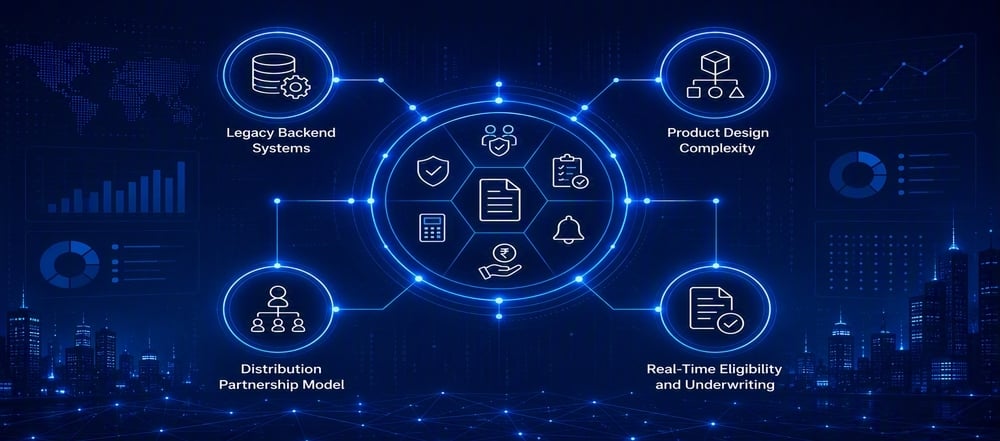
Legacy Backend Systems: Many insurers operate on standalone policy administration systems built decades ago. These systems were not designed for real-time API interactions or high-volume, low-premium transactions. This requires insurers to either undergo costly modernization efforts or partner with intermediaries who can bridge the technology gap.
Product Design Complexity: Creating insurance products that work in embedded contexts is different from traditional product development. Coverage must be simple enough to explain in seconds, yet comprehensive enough to provide real value. We will explore this further in Part 3 of this series.
Distribution Partnership Model: Success depends on finding and enabling the right distribution partners. This requires new business development approaches, different compensation structures, and careful partner management.
Real-Time Eligibility and Underwriting: Building systems that can accurately assess risk and determine eligibility in real time, without human review, requires sophisticated data integration and decisioning capabilities.
Of these four, this piece focuses on the two that are technological: Legacy Backend Systems and Real-Time Eligibility & Underwriting. Product Design is covered in Part 3.
The Technology Enabler: Building for Real-Time Integration
In a successfully deployed model, the user experience is controlled by the partner platform. Behind the scenes, the insurer exposes its capabilities through simple, stateless APIs that connect to an automated underwriting engine.
This connected platform capabilities include -
- Real-time quote generation via API - The partner's system calls a quoting API at checkout, which must instantly return a bindable, compliant quote to avoid abandonment. That speed comes from rating logic that's pre-computed or cached, not run as a full actuarial calculation on every request.
- Seamless sales integration embedded into the partner's ecosystem. The offer renders natively inside the partner's own checkout UI, using the insurer’s logo and under the partner’s UX branding. This is achieved through embeddable components or a headless API that allows the partner to control the experience within their ecosystem.
- Automated underwriting using rules-based decision engines. An automated rules engine, backed by machine learning algorithms, replaces the human underwriter. There's no referral queue. Cases that don't cleanly resolve get excluded from the product rather than escalated to a person.
- Real-time data integration across multiple sources for eligibility and pricing. The platform calls multiple third-party sources, including Identity verification, device or warranty registries, flight-tracking and weather feeds, and fraud databases in parallel to feed the parameters to the decision engine for a fast decision.
- Rapid claims processing for frictionless service. Claims must adapt to the same framework and allow users to digitally submit claims, enabling straight-through processing as much as possible. Payout runs through the same rails as the original purchase or through the partner's own fulfillment systems.
Together, these five capabilities let the insurer operate as a set of composable services rather than a monolithic policy admin system — each one scalable and testable on its own, so plugging into a tenth partner takes no more effort than the first.
Key Drivers: A Win-Win-Win Ecosystem
By embedding themselves into retailers, fintech apps, and other platforms, insurers gain direct access to highly engaged audiences at the exact moment their risk awareness is highest. This creates a seamless value exchange between three core stakeholders:
| Stakeholder | Key Business Benefits |
| Retailer / Fintech | Owns the customer experience, boosts customer loyalty, and builds cross-sell opportunities via a native sales platform. |
| The Consumer | Enjoys a frictionless, integrated checkout experience with instant peace of mind. |
| Insurance Provider | Unlocks massive distribution scale, lowers customer acquisition costs, and accurately underwrites risk using real-time data. |
This ecosystem-based business model thrives on integrated services. Insurance becomes another value-added layer in comprehensive ecosystems, from travel platforms to e-commerce marketplaces.
Looking Ahead
Embedded insurance represents a powerful shift in insurance distribution and a new revenue channel for insurers. The winners will not be the carriers with the largest product portfolios, but those that can expose underwriting, policy, and claims capabilities as scalable digital services consumable by any ecosystem partner. Getting the infrastructure right is only half the job. In Part 3, we turn to the other half: designing coverage simple enough to explain in seconds, yet real enough to matter when a claim is filed.