




Every business, big or small, is managing a considerable amount of data generated through its various data points and business processes. At times, businesses are able to handle these data using excel sheets, access databases or other similar tools. However, when data cannot fit into such tools, and human error instances increase above acceptable limits due to intensive manual processing, it is time to think about Big Data and analytics.
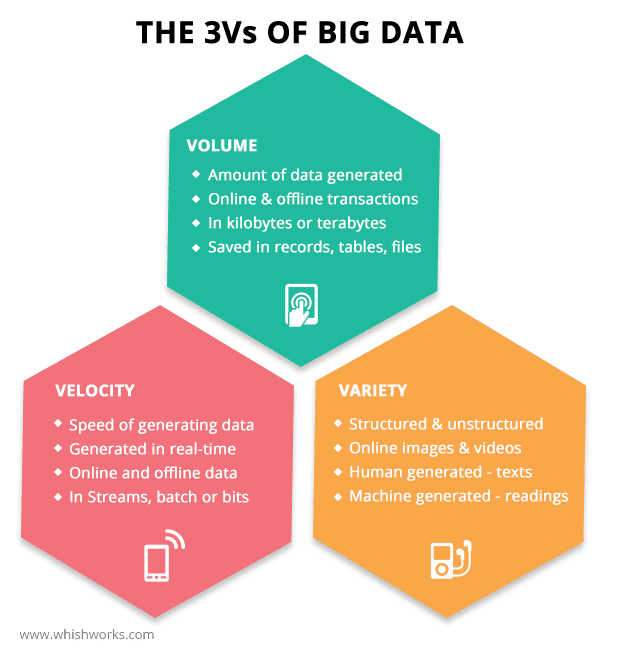
In this article, we are talking about how Big Data can be defined using the famous 3 Vs - Volume, Velocity and Variety.
- VOLUME
Within the Social Media space for example, Volume refers to the amount of data generated through websites, portals and online applications. Especially for B2C companies, Volume encompasses the available data that are out there and need to be assessed for relevance. Consider the following -Facebook has 2 billion users, Youtube 1 billion users, Twitter 350 million users and Instagram 700 million users. Every day, these users contribute to billions of images, posts, videos, tweets etc. You can now imagine the insanely large amount -or Volume- of data that is generated every minute and every hour.
- VELOCITY
With Velocity we refer to the speed with which data are being generated. Staying with our social media example, every day 900 million photos are uploaded on Facebook, 500 million tweets are posted on Twitter, 0.4 million hours of video are uploaded on Youtube and 3.5 billion searches are performed in Google. This is like a nuclear data explosion. Big Data helps the company to hold this explosion, accept the incoming flow of data and at the same time process it fast so that it does not create bottlenecks.
- VARIETY
Variety in Big Data refers to all the structured and unstructured data that has the possibility of getting generated either by humans or by machines. The most commonly added data are structured -texts, tweets, pictures & videos. However, unstructured data like emails, voicemails, hand-written text, ECG reading, audio recordings etc, are also important elements under Variety. Variety is all about the ability to classify the incoming data into various categories.
So why Big Data is needed anyway?
Data are generated incessantly containing nuggets of valuable insight, critical for business success. The challenge is how to analyse and process these data in order to derive those nuggets of information set to strengthen business strategy, efficiency and performance -be it customer feedback, market trends, demand for a product or competitor activity. Big Data solutions help companies make sense out of random information, become proactive and start setting the pace instead of continuously putting out fires and following competition.
If you would like to find out more about how Big Data could help you make the most out of your current infrastructure while enabling you to open your digital horizons, do give us a call at +44 (0)203 475 7980 or email us at Salesforce@coforge.com
Other useful links
- Big Data becomes necessary when data outgrows tools like Excel or Access and manual processing drives up errors.
- The 3 Vs define Big Data: Volume (how much data), Velocity (how fast it is generated) and Variety (structured and unstructured formats).
- Variety spans structured data (text, images, video) and unstructured data (emails, voicemails, audio, sensor/ECG readings).
- The goal of Big Data is to turn high-volume, fast-moving, mixed-format data into actionable business insight — helping companies act proactively rather than reactively.
Q1: What are the 3 Vs of Big Data?
A: The 3 Vs are Volume, Velocity and Variety. Volume is the sheer amount of data generated, Velocity is the speed at which it is created and must be processed, and Variety is the range of structured and unstructured data formats. Together they define the scale and complexity that traditional tools cannot handle.
Q2: What is Volume in Big Data?
A: Volume refers to the amount of data generated through websites, portals, applications and business processes. For consumer-facing businesses in particular, it covers the vast pool of available data that must be assessed for relevance — from social posts and images to transactions and logs generated every minute.
Q3: What is Velocity in Big Data?
A: Velocity is the speed at which data is generated and needs to be processed. Data can arrive as a continuous, high-speed stream, and Big Data platforms are built to absorb this incoming flow and process it fast enough that it does not create bottlenecks.
Q4: What is Variety in Big Data?
A: Variety is the mix of data types produced by humans and machines. It includes structured data such as text, images and video, as well as unstructured data such as emails, voicemails, hand-written notes, audio recordings and sensor readings. Handling Variety means being able to classify incoming data into usable categories.
Q5: Why do businesses need Big Data?
A: Data continuously contains valuable insight that is critical to business success. Big Data solutions help companies analyse and process large, fast, mixed-format data to extract insights on customer feedback, market trends, product demand and competitor activity — enabling them to become proactive and set the pace rather than react.
- Big Data: Data sets too large or complex for traditional tools, requiring specialised platforms to store, process and analyse.
- Volume: The total amount of data generated across sources and business processes.
- Velocity: The speed at which data is generated and must be ingested and processed.
- Variety: The range of data formats — structured and unstructured — produced by humans and machines.
- Structured vs Unstructured Data: Structured data is organised and easily searchable (e.g., tables, text); unstructured data has no predefined format (e.g., emails, audio, video, sensor readings).